From Reference to Original Layout: A Research Workflow
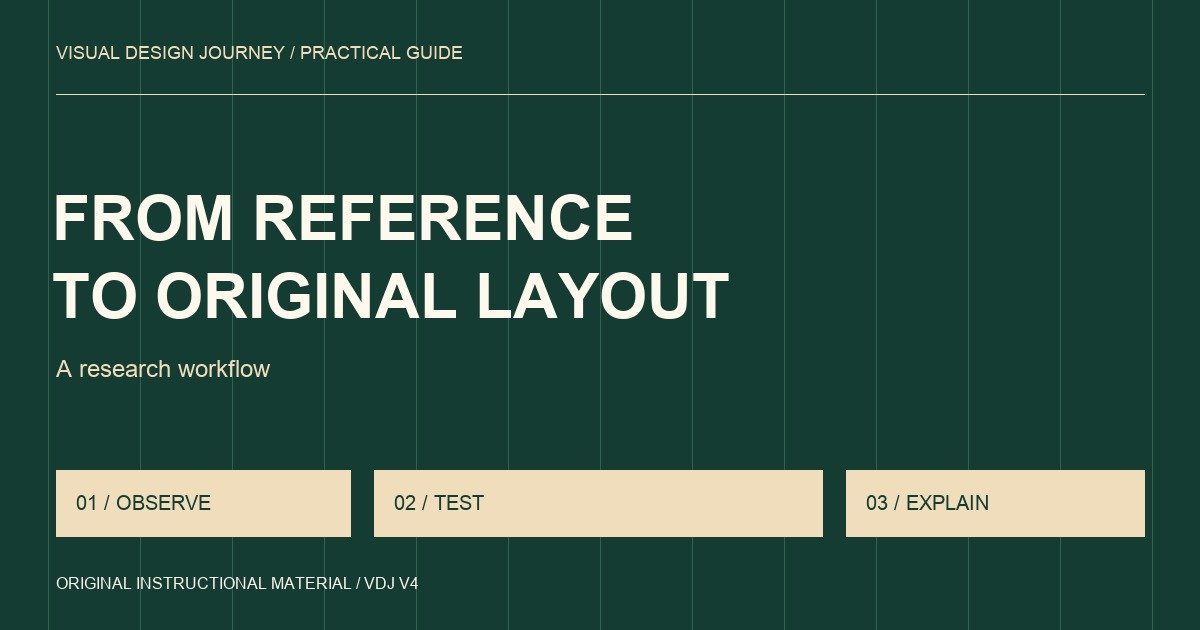
A useful reference should help you explain a design decision, not replace the decision. Start with a question, keep a record of what you actually observe, and test the underlying idea with different content. The outcome is a layout you can explain without borrowing the identity of the source.
This workflow separates collecting, interpreting and making. It is an editorial practice, not a claim that every project follows the same creative sequence. A small research log is more useful than a large moodboard whose sources and purpose have disappeared.
Begin with a question you can test
“Find something inspiring” produces a collection without a stopping point. “How can a reader distinguish an event date from an application deadline?” gives the research a job. Write the problem in terms of information, audience and action before searching for a particular aesthetic.
For a practice brief, imagine an independent design workshop with a title, a short description, a date, a venue and a booking action. These are invented teaching materials. No client project, commercial outcome or usability study is implied.
Choose one uncertainty: whether the date belongs beside the title, whether the venue needs its own block, or whether a long description competes with the booking action. Keep that question visible while collecting references.
Record the object before interpreting it
Save the collection page, creator, title, recorded date and object identifier. Record which version you examined. A book spread, a poster and a photographed exhibition installation can show related material while being different objects.
For example, MoMA identifies Cassandre's Dubo Dubon Dubonnet as a 1932 lithograph, object 158.1950. That is a compact example of a traceable source record. The museum record supports those catalogue details; it does not automatically support your interpretation of the composition.
Add a separate observation column. “Three adjacent panels repeat a figure” describes something to inspect. “The repetition makes the sequence easier to remember” proposes an effect. The second statement needs to remain an interpretation unless you have evidence about actual readers.
Turn observations into hypotheses
Translate the observation into a relationship that could survive different content. Instead of “use this poster's composition,” try “repeat a consistent label position so the changing information becomes easier to compare.”
Write down what you will deliberately change: subject, imagery, proportions, typography and sequence. If the reference disappears and the proposed layout still needs the source's distinctive arrangement to make sense, the hypothesis may be too dependent on the example.
Use several references to challenge the hypothesis. Look for a counterexample that solves the same information problem differently. Agreement between references is interesting; a productive contradiction is often more useful.
Make a neutral version first
Set the workshop information in a simple single-column layout. Give every item its actual wording. Avoid a dramatic image or decorative headline until the reading order works with plain text.
Now make one controlled variation. Keep the words constant while changing grouping, alignment or spacing. If you change the headline, image and grid simultaneously, it becomes difficult to explain which change improved the result.
Compare both versions against the original question. Can you locate the deadline? Does the venue look like part of the description? Does the action remain available when the title wraps? These are review questions, not proof of better conversion.
Keep the result reproducible
Record the viewport, text, font choices and the particular constraint you changed. Include one failure: a long venue name, a translated label or an enlarged text setting. A specimen with only ideal content cannot show where the decision breaks.
| Source record | Observation | Working hypothesis | Original test | Result |
|---|---|---|---|---|
| Collection URL and object ID | What can be inspected | What might explain it | Different content and one changed variable | What worked, failed or remains uncertain |
Finish with a short decision statement: “I grouped date and venue because both are needed to decide whether to attend; I kept booking separate because it is the action.” This tells another designer what to reconsider if the brief changes.
Continue the practice
Use the font-pairing guide to review the typography after the information structure is stable. For your next exercise, develop the same invented workshop through a grid calculation, a mobile adaptation and a critique exercise.
Download the research log (CSV) to keep observations, hypotheses and original tests in one place.
This workflow is free. If you would like to support independent design publishing, explore the current Premium membership and review its included benefits before joining. A membership is not a promise of project results.
Source and editorial note
MoMA — A. M. Cassandre, Dubo Dubon Dubonnet supplies the catalogue example. The research method, workshop brief and decision log above are original instructional material. No artwork reproduction is included.
Comments (0)
- No comments yet. Start the conversation.